Dark spots inside your copper bottle: normal and safe?
Brown and black patches inside your new copper bottle after a single night? What you are seeing, whether it is safe to drink from, why half a lemon cannot reach and how to get the inside properly clean.
Written and source-checked by the Kopero editors · Updated September 16, 2026

Dark after just one night?
You fill your new bottle with water in the evening, and the next morning you look inside: brown, almost black patches, scattered unevenly over the wall. You polish with lemon and salt (not too hard: salt is mildly abrasive and dissolves well in the lemon juice), it gets lighter, but the patches are still there. Two questions follow: is this normal, and can I still drink from it?
The answer to both is yes. Below is what you are seeing, why it starts out patchy in a new bottle, what has been measured about copper in your water and how to get the inside properly clean.
In short
- The dark patches are a thin layer of copper oxide. It starts to form as soon as new copper comes into contact with drinking water.
- In a new bottle that layer often starts out patchy. With use, the colour usually evens out.
- It is safe to drink from. After sixteen hours in copper, 0.18 milligrams of copper per litre was measured, and EFSA considers 5 milligrams a day safe for adults.
- As copper ages, it releases less dissolved copper into the water.
- Green or blue on the inside is something to remove before you refill. Brown and black can stay.
- Half a lemon cannot reach the wall of a bottle. Shake lemon juice and salt in the closed bottle, or use citric acid.
What you are seeing
Copper reacts with water and oxygen. That forms copper oxide on the surface: first a brown to almost black tint, and only much later, with moisture and carbon dioxide involved, sometimes a greenish one. Researchers at the US Environmental Protection Agency (EPA) followed new copper in drinking water and saw that this oxide starts to form straight away. So it is not dirt and not wear, it is simply what copper does. Why copper changes colour on the outside too is explained in why copper turns green or black.
Why it starts out patchy
The inside of a new bottle is not yet the same everywhere. Where a drop was left after rinsing, where a finger touched the rim or where a trace of lemon stayed behind, the copper reacts slightly differently from the area next to it. The first night with water makes those differences visible, which gives you an irregular pattern of light and dark patches. After a number of fills, the colour usually settles into a calmer, warm tone.
Look at the bottom and you will see a few rings. Our bottle is formed from a single piece of copper, with no seam and no solder, and those rings come from that forming. That is often exactly where the copper colours first, sometimes with a purplish sheen. That too is simply a thin layer of copper oxide, and it can stay.
If you use filtered water, that can speed things up. A filter cartridge with an ion exchanger removes part of the limescale from the water, and the Dutch fact sheet on water hardness explains that softer water dissolves copper more easily. Filtering is fine, and so is tap water. How hardness plays out otherwise is in soft or hard water in a copper bottle.
Is it safe to drink from?
Yes, and that has been measured.
In a study in India, drinking water stood in copper pots for sixteen hours. Afterwards it contained 0.18 milligrams of copper per litre, about a tenth of the European limit for tap water. A full 900 ml bottle therefore comes to around 0.16 milligrams. The European Food Safety Authority (EFSA) considers 5 milligrams a day safe for adults and confirmed that limit again in 2023. What copper does in your body is in is copper water healthy.
The dark layer works for you rather than against you. The same EPA study notes that copper pipes release less dissolved copper into the water as the years go by, because the layer turns into forms that dissolve less easily.
Our own bottle has been tested too, with distilled water, for two hours at 40 degrees and repeated three times. It met the European rules for materials that come into contact with food, and none of the nineteen heavy metals tested for could be detected in the water. The results are in the test file.
When you do clean it
Brown and black can stay: polishing is for the shine, not for safety. There are three moments when it is worth giving the inside some attention:
- before first use, so you start with clean copper;
- when you see green or blue deposits: that is verdigris, and you remove it before refilling the bottle;
- when the water smells or tastes different from what you are used to.
How to clean the inside
Half a lemon does not get you far inside a bottle: the neck is too narrow, so at most you polish the top few centimetres. That is why the patches often remain after such a polish. A mixture that you move through the bottle does reach everywhere.
- Put the juice of half a lemon and a tablespoon of coarse salt into the bottle, with a splash of lukewarm water.
- Screw the cap on and shake for a minute or two, so the mixture runs along the whole wall.
- Leave it for a few minutes at most.
- Rinse the bottle out thoroughly a few times with warm water. Acid left behind is exactly what causes new marks.
- Stand it upside down and open until the inside is completely dry.
Rather not use lemon? Dissolve a teaspoon of citric acid in a cup of lukewarm water and use it the same way. Which products to leave alone, such as vinegar for soaking, bleach and descaler, is covered in cleaning copper: soda, vinegar, lemon or citric acid.
Do not expect a bottle like day one after a single round. The mixture makes the colour lighter and calmer, but a few faint patches may remain. They become less and less noticeable with use.
How to keep it calm
Rinse the bottle with warm water after every use, let it drain upside down and only put the cap on once it is dry. Fill it with still water only, and drink it within a day. Those habits, and what most often goes wrong, are listed in 8 mistakes with a copper bottle. The full routine for inside and outside is in caring for a copper bottle, and step by step in the water bottle guide.
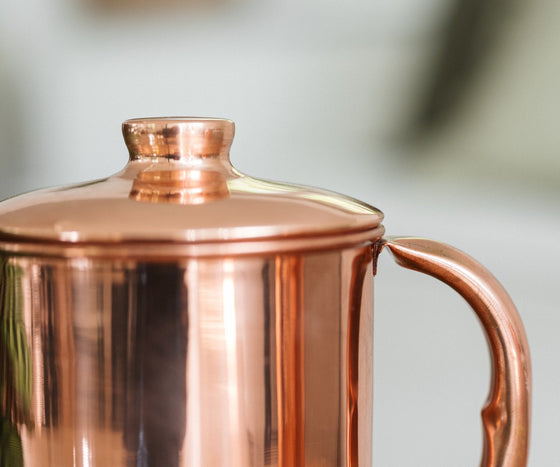
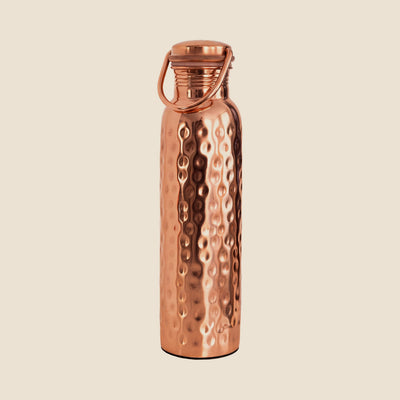
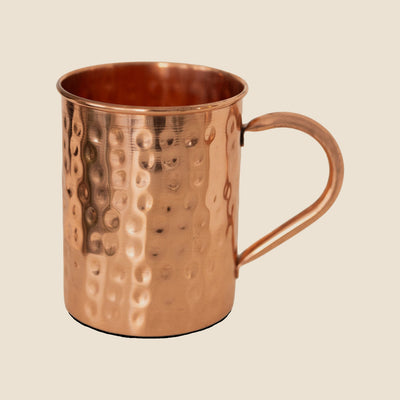
Where our copper comes from is in what our copper products are made of. Take a look at the water bottle, the cup or the jug.